Aleta Chossek
  • Stories
  • Kristine, Finding Home
  • Photos
  • Resources
  • About & Contact

Stories & More

Here on my website you will find some of my writing, and a lot about my grandmother, Kristine Kristiansen Hjelmeland of Kristine, Finding Home: Norway to America.  The site is new so come back again for changes and updates.
​
I have been writing personal essays and family stories for  years.  With the help of a community of writers, I have learned a lot about the craft and even more about myself.  Maybe some of my writing will inspire you to tell a story.
 
 If you are interested in origin stories, immigrant stories and family stories, you will find letters, photos and writing here​ to interest and inspire you to write your story.  If you are family looking for more information, you will find links to my primary source material and genealogy. If you enjoyed Kristine, Finding Home and want to explore themes of heritage, home, ambition, women’s changing roles, more, check out my blog.
Kristine, Finding Home

Resources for Family
About & Contact

Case Study Conclusion

8/16/2026

0 Comments


Read More
0 Comments

Case Study Continued

2/21/2026

0 Comments

 
​After Fredrik built a shanty and planted his first crop of wheat, he  sought out construction jobs.  To meet the requirements to make the land his, he lived on the claim for three months during the spring planting season for wheat and three months of harvest.  During the intervals between those times, he was close enough to growing towns to take on electrification jobs in Canada, Montana and the Dakotas.  If needed, he could do masonry and even carpentry.   Though there were defined borders, there were no actual border checkpoints established between Canada and the U.S.  until the 1920’s.  Fredrik moved freely between his land and northern Montana.  When he had completed all the homesteading requirements, not only did he own the land outright, he also became a Canadian citizen.
During the years 1914-1919, Fredrik had become independent of Mikal’s mentorship.  Letters were sent to Mikal in Chicago or Whitehall, WI from Fredrik in Moose Jaw, Saskatchewan or Minot, North Dakota.  Most of the available land for settlers in Wisconsin, Minnesota and the Dakotas had been claimed and developed.  The railroads were established and there was less demand for workers.  The burgeoning West drew Fredrik for the opportunities of homesteading but unlike the first settlers, he also invested in  land others had cleared and built on.  He improved his properties by electrifying  the structures. His letters detailed his daily life.  He wrote of women he was seeing, poker games during the winter months, the difficulty of supplies getting to his homestead claim, construction jobs he had or hoped to get.  His letters were dominated by reports of land deals that he did on behalf of himself and Mikal.  His entrepreneurial spirit was evident in these letters that included so much more than clearing land and growing wheat.
“I have one thing on my mind that I would like to ask you, and that is, if you would mind very much if I were to join the (Canadian) army?  You see, I’ve got another nine months to put into the land and I don’t need to be there any more if I enlist.”  Fredrik writing to Mikal,
Swift Current, Saskatchewan
July 12, 1916   
World War I kept both Fredrik and Mikal in America.  Norway was officially neutral but it’s large naval fleet, strategic position for sea battles, and supply of fish to feed troops was of strategic importance to the Germans and the United Kingdom.  The brothers worried about the farm, the well-being of their father and sisters and remaining brother.  The North Sea was too dangerous to consider going home so they continued to work and invest their earnings, looking to the future.  Fredrik, the younger brother even considered going to fight for Canada 
 
“Received your letter just one hour ago, and I see that you are serious about your returning to Norway…..I am glad that you are going home.  You may think it strange for me to say that I am happy about your leaving me, but you know what I mean.  Just now your place is at home, so you can begin making a decision about your future.   Here you were never sure of anything about the future and had to live accordingly---almost like a gypsy.”
Fredrik writing to Mikal
Regina, Saskatchewan
February 5, 1919
By the time WWI was over and it was safe to travel, Mikal was 40 years old.  In this letter, Fredrik is encouraging Mikal to claim ownership of the family farm in Norway, marry and start another generation.  Even though he had spent over 15 years in America, Mikal never gave up his right to the farm in Bygstad. Within a year of returning to Norway, Mikal was married and expecting his first child.  
  Fredrik continued to work day by day, and week to week wherever he found himself, in his words “like a gypsy”, for a few more years but he too began to long for a more stable future.  For him it was in America.  
0 Comments

Case Study Continued

8/26/2025

1 Comment

 
​Mikal was a brick-layer mason and Fredrik had his electrical certification.  Their plan was to work construction in the rapidly expanding cities of the Midwest and Canada while also dealing in real estate.  The lure of land ownership drove Fredrik, the son who was unable to inherit.  Single men, they were able to roam the Upper Midwest and Western Canada to wherever work was available.  Mikal’s contacts in existing Norwegian American communities helped find those jobs.  
 By this time, chain migration was well established in the Midwest.  Chainm migration is the phenomenon of existing settlers encouraging others, relatives or neighbors, to migrate to the same area where they had established a foothold.  Whole towns spoke specific Norwegian dialects.  The men learned English to conduct business outside the community but often women lived their entire lives in rural Midwest and never learned to speak English.  It is not unlike ethnic enclaves now in our cities and suburbs.  Immigrants naturally seek out those who are like them, speak the same language, eat the same foods and celebrate in similar ways.
  Mikal was well known in the area around Hixton and Whitehall Wisconsin where others from Sunnfjord were farming.  From that base, Mikal and Fredrik hired out, initially as farm workers and in the winter joined the logging crews in Rhinelander, Wisconsin.  Day laborers, they quickly learned of construction projects both in the communities near them but also in bigger towns like St. Paul, Minnesota or Chicago, Illinois.  As they moved around, they stayed in rooming houses where they met even more men like themselves seeking opportunities for advancement.  It was this itinerant lifestyle that helped them learn English and gain a wider view of American life.  Fredrik was soon traveling on his own to install electricity in commercial buildings.  Letters began to arrive back in Norway from places like Glasgow Montana and Pierre South Dakota.  
“As you will see from this letter, I am still in Montana in a small town called Glasgow.  Mikal is here, too, and we have good work both of us, he as a bricklayer and I as an electrician.  We will stay here until Christmas.  Then I may go and see the land I own.  I’m happy as long as Mikal is here….It’s in Canada we bought some lots, and it is quite impossible to sell them again because times are hard due to this terrible war.  But hopefully, it will soon be over and Canada will become just as good as before.”
Letter from Fredrik to his sister Anna in Norway.
Glasgow, Montana
October 11, 1914
 
By 1914, Fredrik pursued his belief that the best investment was in land, by staking a claim to 160 acres under the Canadian Dominion Land Act of 1872.   By then, the Dominion Land Act in Canada and the Homesteading Act in the United States had encouraged thousands of people to settle and farm in the Great Plains of North America and displace the indigenous people who had called this vast area home.                                       
 Because he was claiming land late in the homesteading era, Fredrik found that the best available land was near Swift Current, Saskatchewan, just north of Glasgow, Montana, where he had been working.  Fredrik did not seem to be concerned that there were few Norwegians among his neighbors.  His belief that wealth lay in land ownership superseded those considerations. However, he was able to commit to homesteading and hardship because he had no wife or family to provide for.  For him, at that time, it was a business decision, an investment in the future.  In order to earn title to the land, he needed to build a habitable structure, occupy it at least 6 months of every year, and clear and farm the land.   

Read More
1 Comment

Fredrik and Kristine Case Study  continues.

8/26/2025

0 Comments

 
​Mikal was a brick-layer mason and Fredrik had his electrical certification.  Their plan was to work construction in the rapidly expanding cities of the Midwest and Canada while also dealing in real estate.  The lure of land ownership drove Fredrik, the son who was unable to inherit.  Single men, they were able to roam the Upper Midwest and Western Canada to wherever work was available.  Mikal’s contacts in existing Norwegian American communities helped find those jobs.  
 By this time, chain migration was well established in the Midwest.  Chainm migration is the phenomenon of existing settlers encouraging others, relatives or neighbors, to migrate to the same area where they had established a foothold.  Whole towns spoke specific Norwegian dialects.  The men learned English to conduct business outside the community but often women lived their entire lives in rural Midwest and never learned to speak English.  It is not unlike ethnic enclaves now in our cities and suburbs.  Immigrants naturally seek out those who are like them, speak the same language, eat the same foods and celebrate in similar ways.
  Mikal was well known in the area around Hixton and Whitehall Wisconsin where others from Sunnfjord were farming.  From that base, Mikal and Fredrik hired out, initially as farm workers and in the winter joined the logging crews in Rhinelander, Wisconsin.  Day laborers, they quickly learned of construction projects both in the communities near them but also in bigger towns like St. Paul, Minnesota or Chicago, Illinois.  As they moved around, they stayed in rooming houses where they met even more men like themselves seeking opportunities for advancement.  It was this itinerant lifestyle that helped them learn English and gain a wider view of American life.  Fredrik was soon traveling on his own to install electricity in commercial buildings.  Letters began to arrive back in Norway from places like Glasgow Montana and Pierre South Dakota.  
“As you will see from this letter, I am still in Montana in a small town called Glasgow.  Mikal is here, too, and we have good work both of us, he as a bricklayer and I as an electrician.  We will stay here until Christmas.  Then I may go and see the land I own.  I’m happy as long as Mikal is here….It’s in Canada we bought some lots, and it is quite impossible to sell them again because times are hard due to this terrible war.  But hopefully, it will soon be over and Canada will become just as good as before.”
Letter from Fredrik to his sister Anna in Norway.
Glasgow, Montana
October 11, 1914
 
By 1914, Fredrik pursued his belief that the best investment was in land, by staking a claim to 160 acres under the Canadian Dominion Land Act of 1872.   By then, the Dominion Land Act in Canada and the Homesteading Act in the United States had encouraged thousands of people to settle and farm in the Great Plains of North America and displace the indigenous people who had called this vast area home.                                       
 Because he was claiming land late in the homesteading era, Fredrik found that the best available land was near Swift Current, Saskatchewan, just north of Glasgow, Montana, where he had been working.  Fredrik did not seem to be concerned that there were few Norwegians among his neighbors.  His belief that wealth lay in land ownership superseded those considerations. However, he was able to commit to homesteading and hardship because he had no wife or family to provide for.  For him, at that time, it was a business decision, an investment in the future.  In order to earn title to the land, he needed to build a habitable structure, occupy it at least 6 months of every year, and clear and farm the land.   

Read More
0 Comments

August 26th, 2025

8/26/2025

0 Comments


​

0 Comments

Beyond the Norwegian American Rural Immigration Story

8/8/2025

1 Comment

 
​Norwegian American Immigration- A Case Study
Beyond the Norwegian-American Farm Communities.
 
 
2025 is the 200th anniversary of the first organized immigration from Norway to the United States.  Fifty-three people arrived near New York City in a sloop named the Restauration on Oct. 9, 1825.  This began a wave of emigration during which over 800,000 people left Norway for the United States, mostly in the period between 1840 and 1910.  My grandfather, Fredrik Hjelmeland was on the tail end of that big wave when he arrived in Halifax, Canada in 1910.  It is also the 100th anniversary of my grandmother Kristine and mother Odny’s immigration.  
Today, among those of us who claim Norwegian American heritage, the anniversary of the first settlers, has heightened interest in migration patterns.  We are curious about how our ancestors decided to leave.  Did they plan to settle somewhere specific?  What did they know about the land they were headed to, the climate, the topography, the soil?  Were they encouraged by a relative or friend that had already left?  What role did religion or politics play in their decision to leave?  How wealthy or poor were they?   
  I have been struck by the ways in which my grandparent’s experiences differ from common experiences and explanations of the time but also differ from each other’s.  In the fifteen years between Grandpa emigrating and Kristine arriving, the world around them had changed.  In the context of changing economies, a World War and the emergence of a middle class in the United States, Kristine and Fredrik brought maturity and changed family situations to their decision making.
Norwegians, including my mother’s family were like all immigrants.  They left their homes and families because of a lack of opportunities.  In Norway, three factors dominated.
  • Arable land in Norway is scarce, but industrialization was hampered by the difficulties of geography, mountains and fjords, scenic but ill-suited for anything but subsistence farming, trading  and fishing. 
  • Religious freedom-Christianity, specifically Lutheranism was the state church, which meant that the local government was closely tied up with who the government chose as pastor for the community.  Quakers, Haugean pietists and other Protestants who espoused lay leadership were moved to emigrate rather than resist both the government and their church.  Other immigrants simply could not be bothered with the strict rules of the church.  Only 25% of Norwegian emigrants stayed with the Lutheran Church in the United States.
  • Education was limited and ended for most with confirmation.  This lack of education limited the economic prospects of fisherman and farmers.  Limiting education assured the upper class a protected status as they could afford to educate their children beyond basic reading and writing.  
Fredrik, my grandfather, was motivated to emigrate mostly by the idea of land.  The youngest of three sons, he came from a family that owned a small farm in Bygstad near the Dale fjord on the western coast of Norway.  Land ownership put his family a step above husmenn, tenant farmers, in social position and wealth.  Husmenn families often were those who emigrated for opportunities that owning land would afford them. 
Because his older brother Mikal would inherit the family dairy farm, Fredrik knew he would need to find work off the farm. By law the farm went to the oldest son in the family. Dividing the farm into smaller parcels of land for inheritance purposes was not permitted.  If Fredrik were to remain farming, he would either have to be able to buy scarce farmland or become a husmann on someone else’s land.  Neither option suited him. 
By the early 1900’s, industrialization and new communication and transportation services were drawing young people from the farms to Bergen and then Kristiania, now Oslo.  Fredrik was among those who saw their future in learning new skills.  In 1909, he earned his certification in electricity from the Kristiania Technical Institute.  To travel across the country and get certified in a technology that no one in his home area had access to, was a bold move for a farmer’s son from a small coastal village.  Fredrik had the vision and drive to know that this was a technology that he wanted to be a part of.  He was motivated to get the education he needed to acquire land.  His time in the city introduced him to more merchants and businessmen who were part of the small but emerging middle class of Norway.  He also saw a way of life that was not as bound by the pietism of his home.  Desire for land, education in a skill and a vision of different ways of life, all made Fredrik ready to emigrate.
While he was in Kristiania, his brother Mikal had come home from America with tales of opportunities for a young person who was willing to work hard. Because their family was still on the farm, Mikal had gone to America to practice his trade of bricklaying and masonry and to earn money for the day when he received ownership of the farm.  When he returned in 1908, Norway had entered a time of deep economic depression.  His hard earned money did not go as far as he had hoped.  In addition, his father was not ready to hand over the farm.  In 1910, Mikal returned to America and Fredrik accompanied him.  Both said they would return to farming in Norway after they made some money.  Only Mikal did.  
1 Comment

Turning Point

8/1/2025

1 Comment

 
​Turning Point
 
Beginning in 1825 but concentrated between 1840 and 1920, over 1/3 of the Norwegian population emigrated to the United States.  My maternal grandparents and my infant mother were among those who came.  World War I and the 1918 influenza pandemic were turning points in diminishing the flow of immigrants but even more impactful was the U. S. Immigration Act of 1924.  
My grandfather’s story begins in 1910 at the tail end of the great influx from Norway. 
 My grandmother and mother came in 1925, among the first to arrive after the Immigration Act changed the way people apply to come to the United States dramatically.  Ellis Island was closed, and immigrants got their visas in their own countries subject for the first time to quotas.
Still, their questions were the same and held in common with many immigrants, questions of identity, community, assimilation, language, religion.  
My Grandfather, Fredrik Hjelmeland worked as a day laborer and as an electrician in construction projects as he roamed the upper Midwest from 1910 to 1923.  In between this work he homesteaded 160 acres in Moose Jaw, Saskatchewan.  His decisions about work and whether to return to Norway were influenced by world events but also by his status as the youngest son, unable to inherit the family farm and by his ambition.
My grandmother, Kristine Kristiansen Hjelmeland married Fredrik in Norway in 1923.  Fredrik returned to Waukegan Illinois immediately to begin work as an independent contractor.  Kristine came in 1925 with infant Odny to make a life in urban Illinois.  Kristine Finding Home is the story of her immigration and the turning points both in their individual lives but also the history of Norwegian immigration.
 
 
Picture
Picture
1 Comment

The Universties are Next

4/8/2025

0 Comments

 
The Universities are next…
 
 I seem to write a blog post about once a year.  This year, 2025 may be the year when I do more.  I had never intended to use this site for personal essays about current issues but these are the times in which we live.  Unexpected things happen.  People voted for President assuming that whoever won would follow the law, respect the Congress and the courts and governing norms.  This has not been the case and as an ordinary citizen there seems to be no place to go with our concerns.  So,  with this post,  I launch a few random thoughts about the issues I am experiencing as the unprecedented administration unfolds.
​
My husband and I are graduates of a small Lutheran liberal arts college in Iowa.   We got an excellent education there that prepared us well for successful careers.  In the tradition of the liberal arts, we learned to look at the big picture, to ask why and why not?
We have watched with dismay the dismantling of science and research programs at major universities and the punitive attack on DEI programs.  Using Federal funding the administration is punishing Columbia University first by withholding $400 million.  Johns Hopkins has had $800 million in grants cancelled.   
Still, we were shocked to learn that a private scholarship that we have funded at our alma mater,  entirely with our own personal funds is being rewritten against our wishes, solely because the scholarship funds were designated to give preference to U.S. students of color or Tanzanian students.  
Redefining the terms of our scholarship fund shocked us because of the reach of this movement against the existing diversity of our society.  If the anti-DEI agenda reaches individual scholarship funds in a tiny sectarian school in rural Iowa, where will this oppression reach next?  Will it stop? Or will it permeate our neighborhoods, our churches, our living rooms? 


​
0 Comments

Belonging to Denmark

3/22/2024

1 Comment

 
Picture
“Family gives us our original sense of identity.  We belong to some people and they belong to us”    Rachel Held Evans    


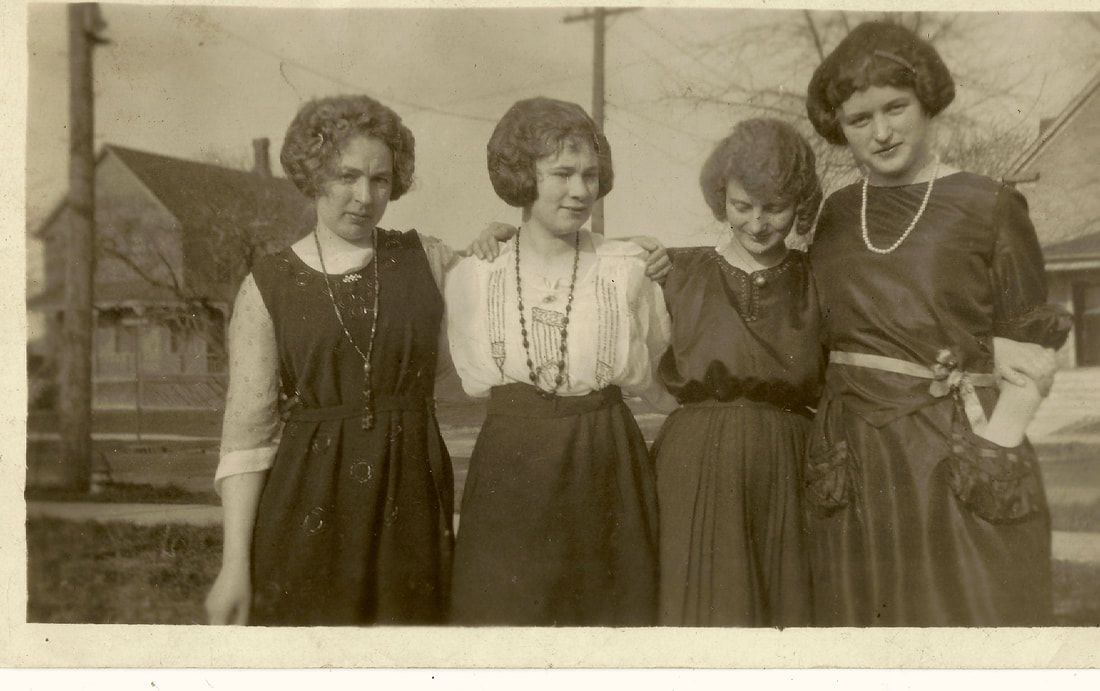
    Martha Marie Hansen was sixteen years old when she, her brother Peter and her sister Anna emigrated from a dairy farm in Denmark on the Jutland Peninsula to Waukegan, Illinois.  Like many single immigrant girls from Scandinavia, she knew no English, had no money and was valued for her marriageability and ability to work hard. A distant relative who owned a rooming house sponsored her passage in return for work as a housemaid.
    Now, over 100 years later, I look for her wedding picture and find a different picture that tells me how little I know about my paternal grandmother.  There is nothing written on the picture, no date, no names of the four young women in their Sunday best, standing arms linked.  That might be because Grandma Reckling, as my siblings and I still call her, had only been educated at her local church until she was confirmed.  She could read and write in Danish enough to sign and date her name and memorize the catechism but recording details about herself was not something she did.  
    I wonder who took this picture, who the other girls are, how soon it was taken after she arrived in Waukegan, why they were all dressed up? I notice the sidewalk, the other houses in background, the electrical poles.  I am only sure that it is her because she is the tallest in the group and her big round eyes staring directly into the camera are mine.  Her thick dark hair pinned in a modest style around a heart shaped face, tells me she has not been in this country long enough to cut her hair.   Like the others, she is wearing a necklace but her dress is cruder, not well-fitted to her, with a ribbon substituting for a waist band. The picture gives me some details of a story I only vaguely know. 

I asked her once how she met our Grandpa? The only part of her answer I remember is that they met at the rooming house where he was staying and she was working.  I wish I had been more curious. Were they attracted to one another right away?  Did I imagine that he caught her eye when she was serving the stew and potatoes the boarders usually got for dinner?  Or was that part of the story she told?  She was still a teenager.  Ten years her senior, he had been a plasterer and union man for over a decade.  An inexperienced farm girl, was she attracted, intrigued or seduced?  He was the grandpa who frightened me with his swearing and demands.  Did he frighten her?  Did she flirt with him or was he the best option to escape long hours of cleaning, washing sheets and serving food?
    I wish I had a letter that she might have written home, some clue to her life then.  I think she told me that her mother and a sister, had died in the 1918 flu pandemic.  Still recovering from the German occupation of World War I, her father could not afford to keep her on the farm.  Is it my imagination or did she still  have younger siblings?  Was she sent away when her father remarried?  A younger brother, Robert, visited Waukegan from Denmark once during the 1960’s.  For Grandma it was very important.  Why hadn’t I paid more attention then?  
     She had come to Waukegan with an older brother Peter, did he write letters home?  Did he and their sister Anna also work at the boarding house?  I know that Grandma’s sister Anna married shortly after they arrived but I don’t know anything about Peter.
    If there are pictures from Grandma’s wedding, none of my siblings or cousins have located them. In family lore, most of her story begins with her eldest son, my father’s birth.  Grandma’s story through him belongs to me.  I record what I know,  so that if my grandchildren wonder about how they might belong to me, they will have a trail to follow for their own questions.  
​      Some distant cousins in Denmark have asked about Marie who went to America through a geneaology site and suggested that Pete and Anna had slightly different stories from mine.  My sister Kristine remembers a different story about Grandpa and Grandma meeting.  Any and all who have information about the meeting and Grandma Marie's early years, or a better story than mine should feel free to post a comment.  It is through sharing stories that we find out who we are.
1 Comment

Widening the connections

5/1/2023

0 Comments

 
Originally,  when I started writing,  I did not envision a book about my grandmother.  I envisioned a telling of the details of both her life and Fredrik's.  How I got to Kristine Finding Home is the subject for another post.  The best outcome of publishing a book and writing it  as a story is to connect with people in a way that speaks to them.  I have had many unexpected people across a wide spectrum read and appreciate Kristine Finding Home which humbles and delights me.  Recently though, I was surprised to find that Kristine's story was used as an example of how to research family history by Daytona Danielsen.  
     Daytona was a journalist specializing in Scandinavian Food writing based in the Seattle area.  I came across her work while doing my research.  I had at one time thought to tell Kristine's story in recipes. Danielsen's  life has changed somewhat but she maitains an active online presence including hosting a book club while writing, working and going to graduate school. She writes about her grandparents, 
 "They, like Kristine, intended to return to Norway after a period of time. They, like Kristine, never moved back. Although much is different between my grandparents’ experience and that of this woman and her family, I appreciated this glimpse into her story, knowing that there is something universal about being human and the way we experience life. Even though I’ll never know much about what it was like for my grandparents to leave Norway, reading Kristine’s story—as written by her granddaughter based on letters, reports, and oral history—expands my understanding of an experience that I’ve never had, and helps me to perhaps understand my grandparents more as well."  Her website daytonadanielsen.com is filled with interesting stories and another way to delve into how we become the people we are.
     Writing down family stories continues to open doors that I never knew existed.  I have discovered a rich and varied community for which I am grateful.  
​ 


​
0 Comments
<<Previous

    Archives

    February 2026
    August 2025
    April 2025
    March 2024
    May 2023
    September 2022
    November 2021
    December 2020
    November 2020

    Categories

    All
    Chossek
    Kristine Finding Home
    Memoir
    Reckling Family
    Review
    Storytelling
    Understanding Heritage

    Immigration
    Entrepreneurs
    ​Emerging Middle class

    RSS Feed

Copyright © 2024 Aleta Chossek
  • Stories
  • Kristine, Finding Home
  • Photos
  • Resources
  • About & Contact